Cell IDS
is a true Intrusion Detection System (IDS) network security appliance
system to prevent intruder's attack. It is deployed for any enterprises
to monitor suspicious external attacks and malicious internal acts. Cell
IDS allows customers to monitor multiple network segments whilst
maintaining a very high network performance throughput. This reduces the
cost of ownership and also lowers the effort in managing a large scale
of network intrusion detection system deployment. Furthermore, it is a
product series of unique network intrusion detection appliances that is
a scalable solution for small to large enterprises and service
providers.
Cell IDS product family includes an
entry-level Fast Ethernet based IDS (F-IDS) and high end Gigabit based
IDS (G-IDS). F-IDS provide up to 300Mbps throughput performance and
monitor up to three network ports. It also has 100Mbps network
performance with up to four Fast Ethernet network interfaces. G-IDS is a
Gigabit performance IDS product specifically designed for high-speed
networks, such as core backbone networks of large enterprises or data
centres. It has up to 2 Gbps throughput performance with a maximum of 4
Gigabit Ethernet network interfaces and 1 Fast Ethernet network
interface for management. In addition, a higher end model of G-IDS with
hardware system redundancy is also available to avoid hardware failure
in any critical network environment.
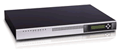
Cell F-IDS
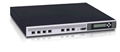
Cell G-IDS
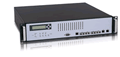
Cell G-IDS/HA
Small and Medium Enterprise
Large Enterprise & Corporation
Large Enterprise, iDC & Service Providers
Key Features:
Breakthrough Throughput Performance
Multi-Segments Monitoring
Custom Secure and Harden Real-time
Operating System
Firewall-like Look-and-Feel
Administration with Java baesd GUI System Console - JConsole
Over 2300 pre-defined IDS Signature Rules
for Intrusion Detection Engine
With Customizable Rules and Instance
On-Line Signature Update via JConsole
SSL and AES encrypted connection to
provide confidentiality and proprietary authentication
LCD display to provide sensor status and
configure the system parameters
Serial port console to provide
troubleshooting and advanced level system provisioning
Centralized Logs Management with Multiple
Sites and Multiple Sensors Configuration